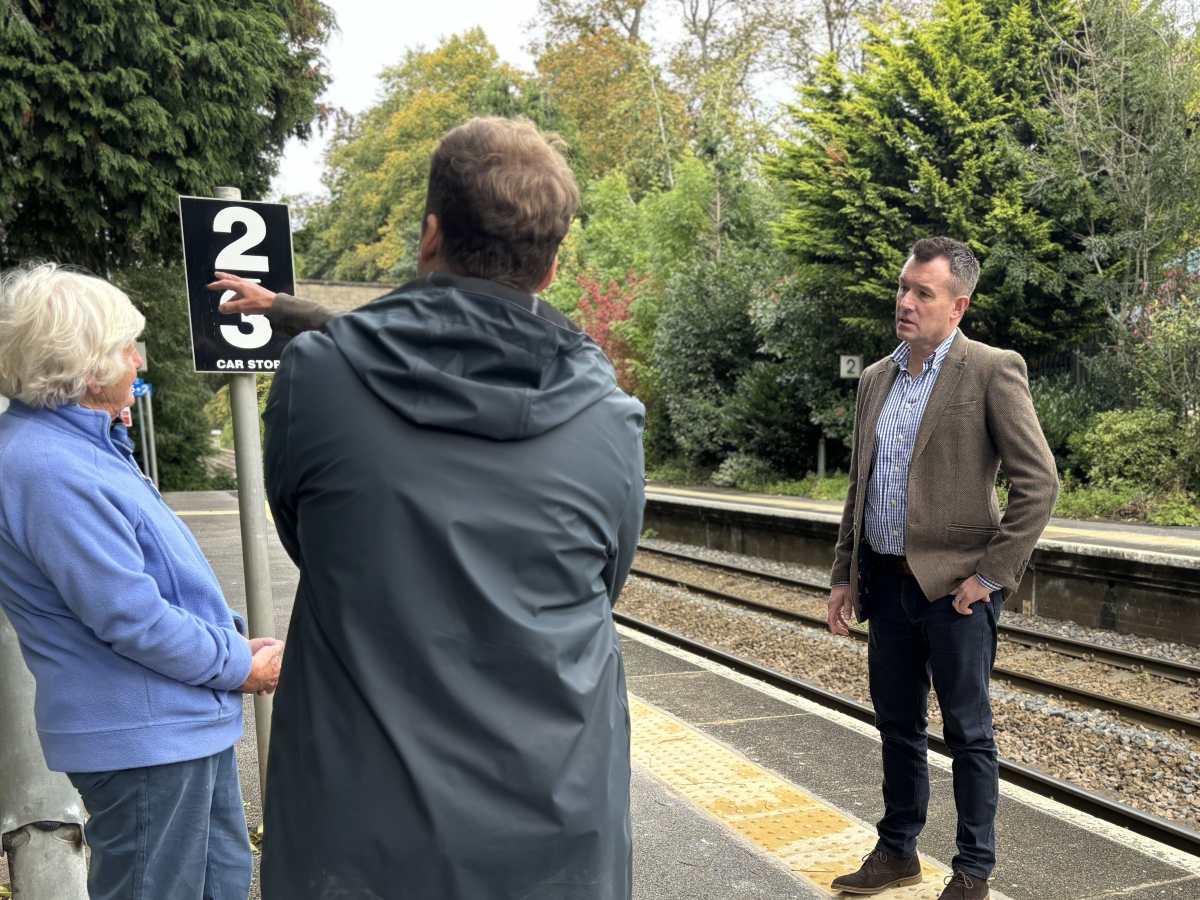
Stuart Anderson MP has launched a blistering critique of the government’s sweeping rail reform plans, accusing Ministers of risking the sidelining of vital South Shropshire train services, including those serving Church Stretton and Ludlow.
The controversy surrounds the ongoing changes ushered in by the Passenger Railway Services (Public Ownership) Act, which is seeing a phased programme of public ownership for Britain’s rail operators. The latest transfer, of Greater Anglia on 12th October 2025, means publicly owned operators now cover a third of the country’s rail journeys, with the full transfer expected by the end of 2027.
Further legislation is set to establish Great British Railways (GBR), a new public body that will assume responsibility for everything from setting timetables to maintaining infrastructure, in a move designed to vertically integrate ‘track and train’ with Network Rail.
However, evidence prepared for Church Stretton Town Council warns the reforms will “negatively impact” local communities, adding there is a “clear risk” that stations along the Welsh Marches line, such as Church Stretton and Ludlow, will suffer from being marginalised by the changes.
A ‘Sidelining’ of Excluded Operators
The core of Mr Anderson’s concern is that services run by open access operators, devolved governments, and local authorities are excluded from the main integration plans. This means operators like Transport for Wales (TfW), which runs services through Church Stretton and Ludlow, will remain outside GBR, while the track they use falls under the new body’s control.
The report highlights the operational difficulty this creates:
“GBR has been conceived purely as an evolution within DfT’s current area of direct responsibility. Operators not contracted by the DfT will remain outside the GBR… This undermines the ability to simplify, as non-GBR operators will still need to navigate complex track access rights and charges…”
Mr Anderson noted that the previous government, which instigated the reforms, had promised a “joint working agreement” between TfW and GBR to improve the rail offer across the connected network between Wales, the West Midlands, and the West of England. Regrettably, the current government appears to have made no visible progress on this pledge.
Instead, Ministers have stated these excluded operators will “remain responsible” for setting their own fares, leading to fears that the Welsh Marches line will be excluded while other services, predominantly in the South East, benefit.
‘Unleashing Rural Prosperity’
The MP’s intervention is part of his wider plan to “unleash rural prosperity” in South Shropshire, citing research from the Country Land and Business Association showing the rural economy is 16% less productive than the national average.
Mr Anderson is also leveraging the Union Connectivity Review, which made the case for improved investment in the Welsh Marches, reflecting that 76,000 people cross from Wales to England for work daily.
Stuart Anderson MP said: “I am greatly concerned that the government’s plans could instead marginalise train services in the Welsh Marches, like Church Stretton and Ludlow… Rail reforms had great potential to end fragmentation and deliver more reliable services with simpler tickets. I have invited Ministers to meet with me and Church Stretton Town Council to discuss these concerns.”
Local concerns were echoed by Mayor Andy Munro, who commented:
“The priority of TfW continues to be connecting north and south Wales at the cost of intermediate stations in Shropshire… An agreement between Westminster and Cardiff is essential to ensure rail services in England are maintained for the benefit of both residents and tourists.”
Ministers, who insist the reforms will make the railway more “accountable, efficient, and reliable,” are expected to table legislation for the creation of Great British Railways in the coming weeks and months. Mr Anderson has urged them to use this opportunity to set out how excluded operators can be brought into the fold.